
The H-1B visa fee was not merely a change in immigration policy, but a new H-1B fee of 100 thousand dollars, which was announced in late 2025. It has fundamentally changed the way the leaders of the US technology are thinking about assembling software teams. The CTOs of Silicon Valley, Austin and New York are chalking the figures and arrive at the same conclusion: nearshore software development in Latin America is no longer an option. It’s becoming the default.
This change is not occurring in isolation. According to the Bureau of Labour Statistics, the software developers are expected to experience a 15 percent employment growth by 2034. In the meantime, the wage of senior developers in San Francisco has increased to an average of more than 198,000 a year. The math is compelling a strategic rethink.
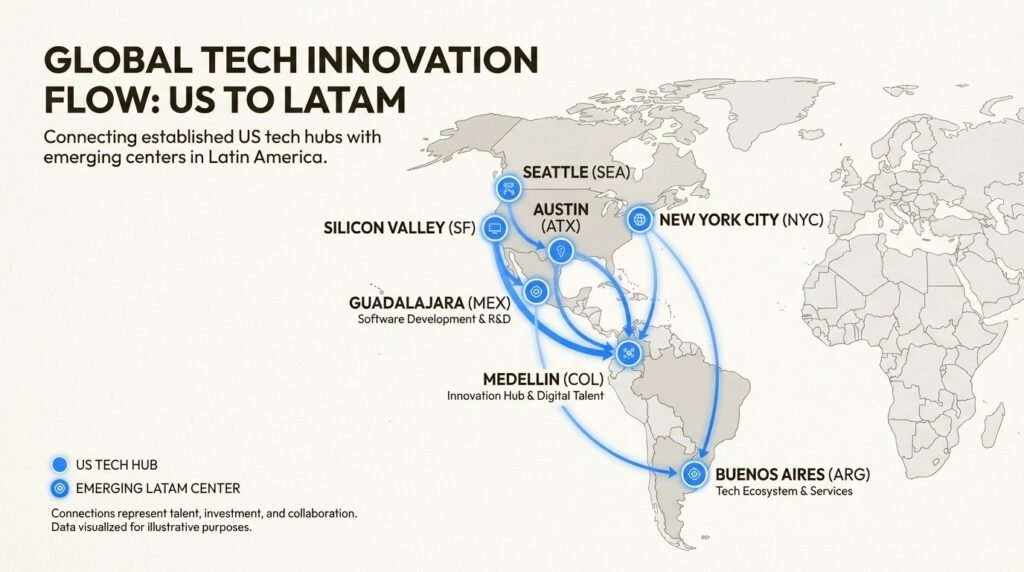
Nearshore development forms direct collaboration bridges between US businesses and Latin American technological skills.
But what exactly are CTOs saying about nearshore software development in 2026? Let’s break down the data, the destinations, and the decision frameworks driving this transformation.
Why nearshore software development dominates CTO agendas in 2026
The H-1B disruption changed everything
For decades, the H-1B visa program allowed US tech companies to access specialised talent at competitive rates. The model worked. Large providers built entire business models around importing talent from India and other countries.
Then came the $100,000 fee per visa application.
This single policy change disrupted the entire IT service ecosystem. Providers maintaining H-1B-dependent models now face millions in additional annual expenses. Those costs flow directly to clients. IT service costs are rising 2-3% for companies stuck in the old model.
The constraint is forcing a strategic pivot. Companies can’t rely on scaling through imported labour anymore. Remote and nearshore teams have shifted from “alternative” to “necessity.”
The total cost of ownership revelation
This is where CTOs are becoming more intelligent regarding the math. The obvious cost play over the years has been offshore development in Asia. Prices of $2550 per hour are competitive compared to $50100 per hour at nearshore.
However, the hidden costs are finally being counted by CTOs:
- Late releases due to 12+ hour time zone differences.
- Overhead of miscommunication of asynchronous coordination.
- The decision-making is being sluggish due to cultural friction.
- Long feedback loops are derailing sprint momentum.
Eric Tabone, CEO of Nearshore Business Solutions, stated it to the point: A developer in Asia, earning $25/hour and needing three rounds of asynchronous clarification and to work when your team sleeps costs more than a Colombian developer making 60/hour and working on your schedule.
The numbers back this up. Companies now report 40-60% cost savings with nearshore models when accounting for the total cost of ownership. Average savings per senior developer range from $50,000 to $100,000 annually.
Time zone alignment as a competitive advantage
The Latin American near-shore software development provides full workday overlap with the US teams. UTC-5 and UTC-3 time zones enable countries to handle same-day responses, timely triaging of incidents, short response and feedback loops, and real-time standups.
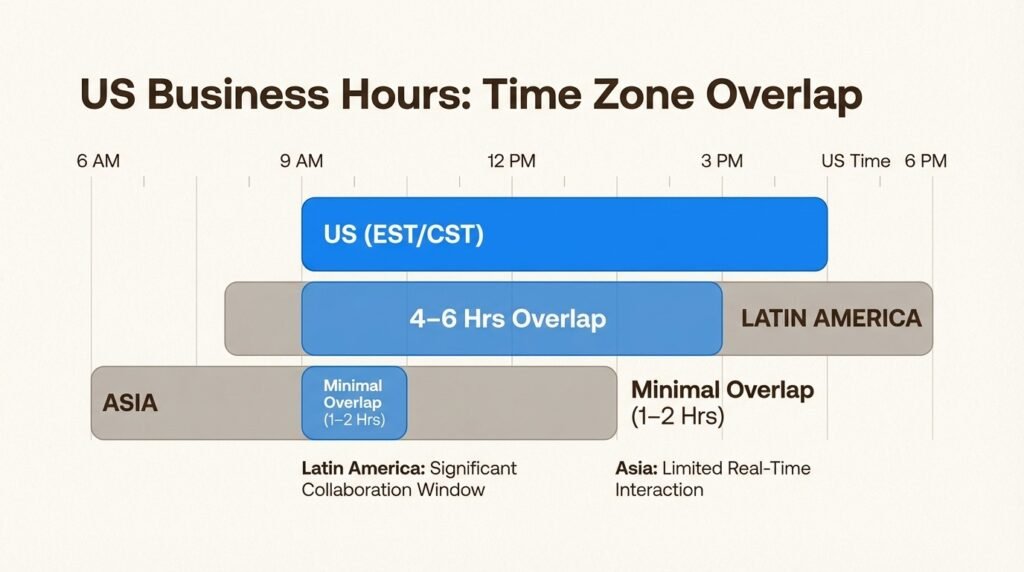
Nearshore teams spend considerable working hours with US teams, whereas offshore teams have to be coordinated asynchronously.
The result? Reduced delivery time, improved predictability, and responsiveness to change. Firms are now focusing on the same-day feedback cycles as opposed to the slight hourly rates.
The numbers: What CTOs report about nearshore ROI
Cost benchmarks across regions
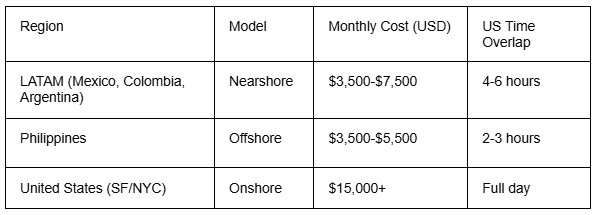
In the centre of the raw costs, Nearshore is beaten by collaboration efficiency. Obtaining the overall cost of ownership usually wins over the offshore options when you consider productivity, communication overhead, and time-to-market.
Hiring efficiency metrics
Speed is important when you need to satisfy a shipment crunch:
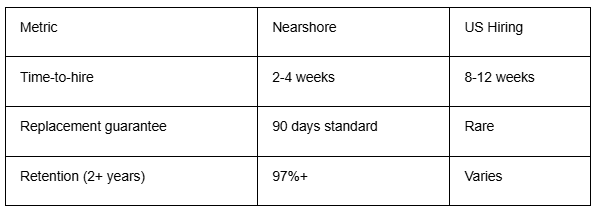
Top nearshore firms have a stringent screening of candidates, with an acceptance rate of 16%. Such selectivity is an advantage in terms of results.
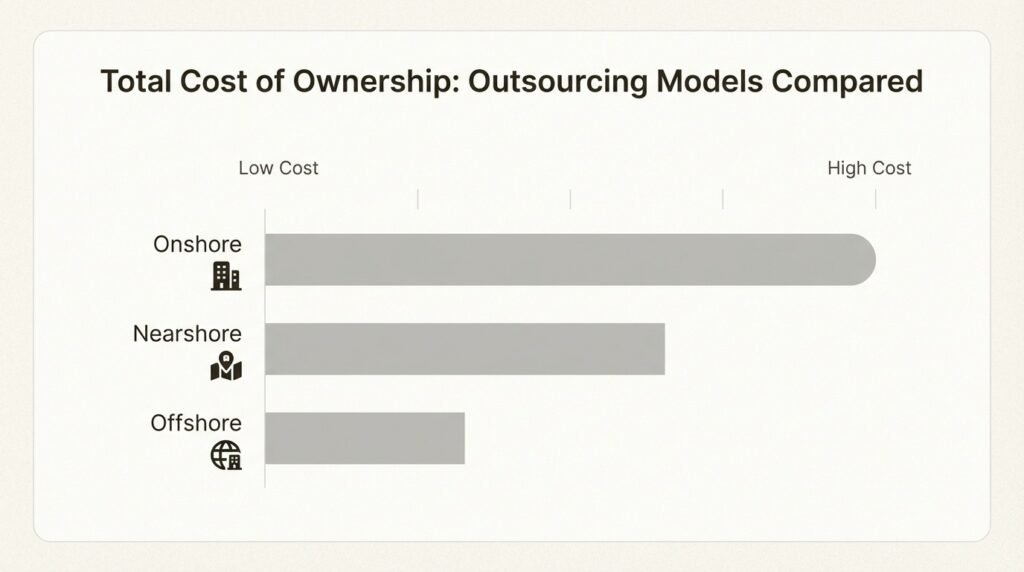
Using productivity, communication efficiency and time to market benefits, Nearshore delivers a 40-60% savings.
Colombia, Mexico, and Argentina: The 2026 nearshore powerhouses
Not all Latin American markets are equal. CTOs are focusing on three countries that offer distinct advantages.
Colombia: Eastern time alignment champion
- 165,000 tech professionals in the workforce
- Ruta N innovation district produces 3,000+ developers annually
- UTC-5 time zone (same as Eastern Time)
- Strong data protection under Law 1581
Mexico: Scale and proximity advantage
- 800,000+ technology experts (the largest in Latin America)
- The semiconductor industry in Mexico is concentrated in Guadalajara (70 percent of it).
- USMCA trade protections
- Tax incentives for the IMMEX program.
Argentina: English proficiency leader
- Best English proficiency in the area.
- Knowledge Economy Law: 15 percent rate of income tax until 2029.
- Work experience at Mercado Libre, Globant and Rappi.
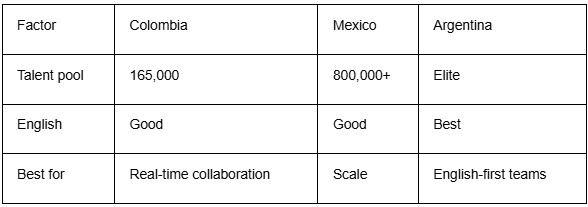
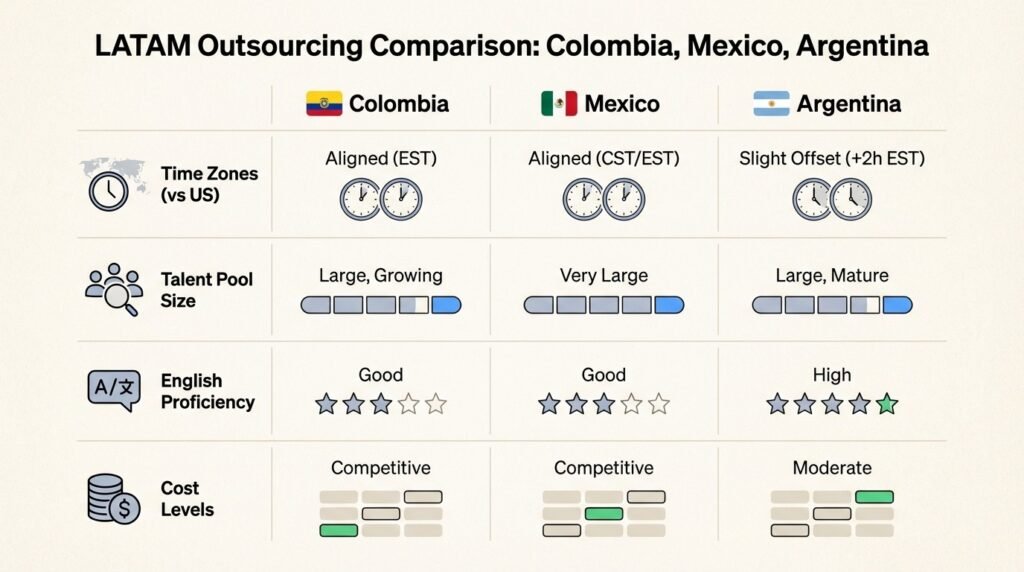
The countries have their own benefits, as Colombia may be more useful in terms of time zone compatibility, Mexico in terms of size, and Argentina in terms of English and tax benefits.
Nearshoring benefits: When it works and when it doesn’t
Ideal use cases
Nearshore isn’t universal. It excels when you need:
- Agile ceremonies through real-time collaboration.
- Projects that demand a lot of feedback.
- Cultural fit with the common business environment.
- Quick scaling in the absence of H-1B ability.
When to reconsider
- Stringent on-premise security demands.
- Sensitivity to cost (extreme cost sensitivity) hourly rate only.
- Clear-cut tasks that do not demand continued cooperation.
- The teams are already optimised to work asynchronously.
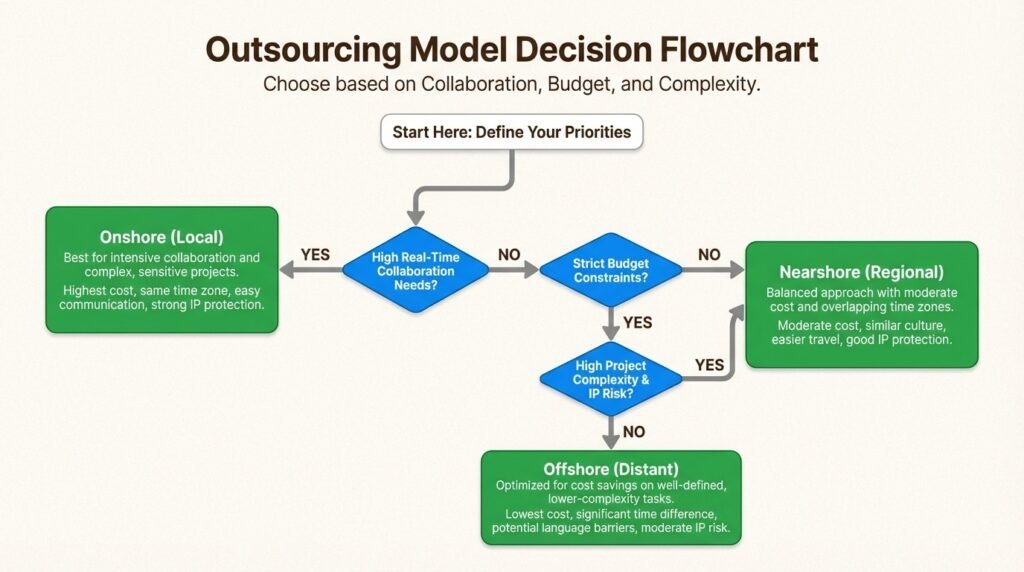
The right outsourcing model depends on your specific requirements for real-time collaboration, cost sensitivity, and project type.
How Soft Tech Cube delivers Software development services
At Soft Tech Cube, we take a different approach. As the industry scurries to incorporate AI in all working processes, our developers do not apply AI to web creation. This will guarantee that every project is given the personalised touch that can not be attained with AI-generated code.
Human-centric development philosophy
- Professionally trained specialists.
- 100% on-time delivery commitment
- Code written by experienced developers who understand your business
Full-spectrum capabilities
We offer comprehensive software development services tailored to your needs:
- Fintech software development for secure, compliant financial applications
- SaaS application development using modern cloud-native architectures
- Custom CRM software development that fits your sales and customer processes.
- Ecommerce software development for scalable online retail platforms
- ERP software development to streamline enterprise operations
We have a team in Toronto that serves our clients in North America and different parts of the world. We provide high-quality solutions that fit your strategic objectives whether you require custom web development, mobile app development, or AI automation services.
Getting started with Latin America developers in 2026
Evaluation framework
Prior to entering into a nearshore company:
- Define collaboration needs. Do you have a need for real-time interaction in your workflow?
- Determine technical requirements. What are your required specialisations? Cloud-native? Fintech compliance?
- Evaluate vetting processes. Do they interview 100+ applications per position?
- Plan integration. How will nearshore developers integrate with existing teams?
Red flags to avoid
- Opaque pricing or hidden fees
- No verification of English proficiency.
- Lacking replacement guarantees.
- Failure to give client references.
Book a free consultation with Soft Tech Cube to discuss your nearshore development needs and explore how our human-centric approach can deliver the quality your projects require.
Frequently Asked Questions (FAQs)
How much can my company save with nearshore software development?
Onshore hiring usually saves a company between 40 and 60 percent in costs. With respect to the senior developers in particular, the annual savings are between 50,000 and 100,000 per developer when considering salary disparities, benefits and overhead. Nevertheless, overall savings will be based on your own needs and the destination of the near shore you will visit.
Which Latin American country is best for nearshore software development?
It will be based on your priorities. Colombia provides Eastern Time correspondence and effective data security. Mexico is the best source of talent (800,000+ specialists) and USMCA protections in trade. Argentina is the top in English proficiency and has a tax incentive till 2029. Assess according to your collaboration requirements, scale requirements, and budget.
How long does it take to hire nearshore developers compared to US hiring?
The average nearshore hire takes around 2-4 weeks to search and start the developer date. The same process takes 8-12 weeks to hire in the US. It is one of the main benefits of nearshore as it allows the company to hire employees much faster, particularly when the company has to expand within a short period or meet stringent product timetables.
What are the main risks of nearshore software development and how can we mitigate them?
The areas of concern include communication, quality and integration with the existing teams. Minimise these by ensuring that the partners they choose conduct rigorous background checks (top providers shortlist 100 or more candidates to fill a single opening), starting their effort with staffing augmentation before they can form dedicated teams, implementing effective communication policies, and using 90-day trial-period policies.