
Good PR is seldom by accident․ Every so often a company will get lucky and the press will discover a story to write about․ Individual posts can go viral․
But you cannot build a reliable reputation on luck․ That is where a PR strategy comes in․
Your PR strategy gives your business a blueprint for building brand awareness‚ securing media coverage‚ reaching your target audience‚ and managing your reputation if something goes off the rails․
PR is changing rapidly as well․
By 2026‚ PR teams are thinking about how to get into the newspapers‚ print magazines‚ broadcast television‚ podcasts‚ creators‚ LinkedIn‚ digital first publications and and even how brands appear in AI-generated answers․
PRSA’s 2026 State of PR research found 80% of PR practitioners use generative AI in their workflows‚ and 73% said generative-engine optimization is at least somewhat important to their communications strategy․
What should a modern-day Public Relations strategy involve?
What Is a PR Strategy?
A PR strategy is a blueprint for affecting perceptions and understanding of your brand. It connects your:
- Business goals
- Target audiences
- Key messages
- Media relationships
- Content
- Reputation management
- Measurement
Consider it to be the road map behind your PR actions.
A team without one can get into a vicious cycle of random shots, posts that no one reads and chasing a media pick-up just because it sounds good. When you have one, there is a reason for every PR activity you have.
What Is Not Part of a PR Strategy?
This needs to be explained as there is a common misunderstanding that PR equals general marketing.
PR strategy is not:
- Randomly sending press releases
- Investigating and paying for all media coverage.
- Pursuit of viral attention with no intention or purpose behind it
- Relying on one campaign to improve the lack of reputation.
- An attitude that success is defined by the number of articles published.
While marketing and PR are similar, PR can help marketing. Credibility, relationships, reputation and earned attention are huge elements of a good PR strategy.
6 Key Elements of a Strong PR Strategy
No need to have a lengthy 50 page document. Use these 6 pieces to begin.
1. Clear PR Goals
The first step is to determine what you want PR to do. For example:
- Increase brand awareness
- Build credibility
- Support a product launch
- Improve reputation
- Generate qualified leads
- Position an executive as an industry expert
Set the goal to be measurable. “Get more attention” is a very general statement.
“Increase relevant media mentions by 25% in six months” gives your team something to work toward.
2. Know Your Audience
Your audience isn’t everyone who might purchase from you.
Ask:
- Who’s your target audience?
- What are their issues?
- Where do they find out the information?
- What magazines do they believe in?
- Who are the creators/experts that influence them?
The answers will help you determine where your PR efforts need to be focused.
3. Create a Strong Story
Nobody wants to cover a company simply because the company exists. There needs to be a reason to care.
Your story could involve:
- Original research
- A new product
- An industry trend
- An unusual customer story
- An expert opinion
- A major company milestone
- A problem your business is solving
This is the point at which numerous feeble PR campaigns fall flat. Rather than something that is truly worth covering, they begin with “We want coverage.”
4. Build Media Relationships
A media list will help. It’s better to have a relationship.
Look for reporters that already write about your field or subject. Read their new work. Listen to them and know their interests. Then make a throw of something relevant.
This is important in 2026 more than ever.
With only 71% of PR practitioners claiming journalists respond at a low level, it’s more important than ever to be targeted and relevant, according to PRSA.
So don’t blast the same pitch to 200 reporters. A smaller list of genuinely relevant journalists can be much more valuable.
5. Prepare for a Crisis
Your PR plan doesn’t need to be limited to good news.
What happens if:
- A customer grips, and a customer complaint goes viral?
- There’s a large outage at your web site?
- A product is required to be recalled?
- A colleague has a controversial comment?
- Wrong info regarding your company is circulating on the internet?
Before it happens, develop basic plans for crisis situations.
Your plan should identify:
- Who responds?
- Who approves public statements?
- Which channels will you use?
- What information must be verified first?
- Who handles journalists?
In a crisis, preparation can save hours.
6. Decide How You Will Measure Results
Don’t measure everything. Select metrics that are related to your goals. Some of the PR KPIs that can be beneficial are:
| Goal | Useful metric |
| Brand awareness | Share of voice, media mentions |
| Reputation | Sentiment, quality of coverage |
| Website interest | Referral traffic, branded searches |
| Leads | PR-driven inquiries |
| Thought leadership | Expert mentions, interviews |
| AI visibility | Brand mentions or citations in AI answers |
Brand awareness, sales/revenue and brand reputation are the top priorities for PR teams, according to Cision’s 2026 PR research.
How to Create a PR Plan
Now you can turn those elements into a practical PR plan. Use this simple sequence:
1. Audit → 2. Set goals → 3. Research audiences → 4. Build your story → 5. Choose channels → 6. Pitch and publish → 7. Measure → 8. Improve
First, check out your old coverage.
- Which stories worked?
- What publications called you up?
- What did not get attention?
- Next, check out the competition.
- What are they being quoted about?
- What are the news reporters reporting on?
- What are the opportunities your brand can exploit?
This will provide you with a much better base than guesswork.
A Simple PR Strategy Template
If you’re in need of a quick PR strategy template, here’s one:
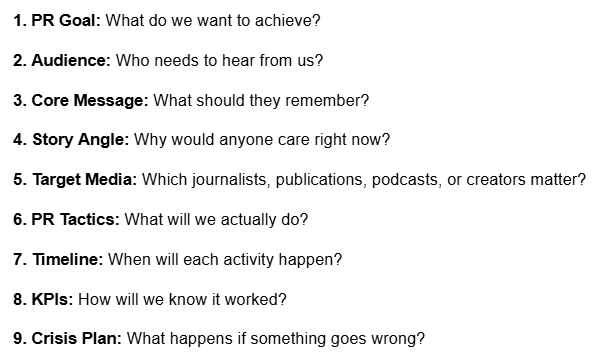
It is then possible to refresh this document as your business and market evolve.
PR Strategy Examples
Let’s say that a software firm introduces a new AI tool.
A weak approach would be:
“Our new AI software is now available. Please write about it.”
A stronger approach could be:
“New research indicates that small businesses are spending X hours per week on this issue and our company has a tool to solve that problem.”
The second angle provides journalists with some content to chew on.
The same goes on a bigger scale for a corporate PR strategy. It could include any or all of the following: executive thought leadership, original research, media relations, industry events, crisis preparation and constant reputation monitoring.
What About Marketing and PR Strategy?
PR should not operate in a completely separate corner of the business. A strong marketing and PR strategy can make both teams more effective. For example, one piece of original research could become:
- A media pitch
- A press release
- A LinkedIn post
- A blog
- An email campaign
- A sales presentation
- A webinar
A positive PR piece may continue to be a positive asset after the media pitch is made.
With the advent of AI revolutionizing the way people find information, this relationship is growing increasingly significant. Earned media are becoming more and more important to what AI systems use and cite when answering questions, PRSA points out.
To Sum Up
A PR plan is not a list of publications you hope will write about your company, it’s a way to determine what you want them to know about you, who needs to know it, why they should, and how you’ll be able to tell whether you are succeeding.
Keep it focused․ Tell stories worth covering․ Build real media relationships․ Measure what matters․ Keep updating the strategy according to changes in the market․
And if your other marketing efforts have to be aligned with PR‚ a Digital Marketing Agency can offer you all of the services you are looking for under one roof․ Moreover, if you are looking for mobile app development or IT services, Soft Tech Cube provides you with tech services for all businesses․
Frequently Asked Questions (FAQs)
How to build a PR strategy?
Get clear on your PR objectives, decide on your target market, develop story angles, choose the media channels, build media relationships, plan your campaign and measure your results.
What are the 7 C’s of public relations?
The 7 C’s are Credibility, Context, Content, Clarity, Continuity, Channels, and Capability.
What are 7 types of PR?
The seven most common types are media relations‚ community relations‚ crisis communication‚ public affairs‚ social media PR‚ internal communications‚ and influencer relations․
What is the 3-3-3 rule for marketing?
In marketing‚ 3-3-3 is the discipline of restricting a campaign to 3 elements: 3 objectives‚ 3 audiences‚ and 3 messages‚ such that the campaign is easier to plan and execute․ Different frameworks describe different meanings for the term․